
Landscape Lighting in Cinco Ranch: What Still Looks Good in Year Three
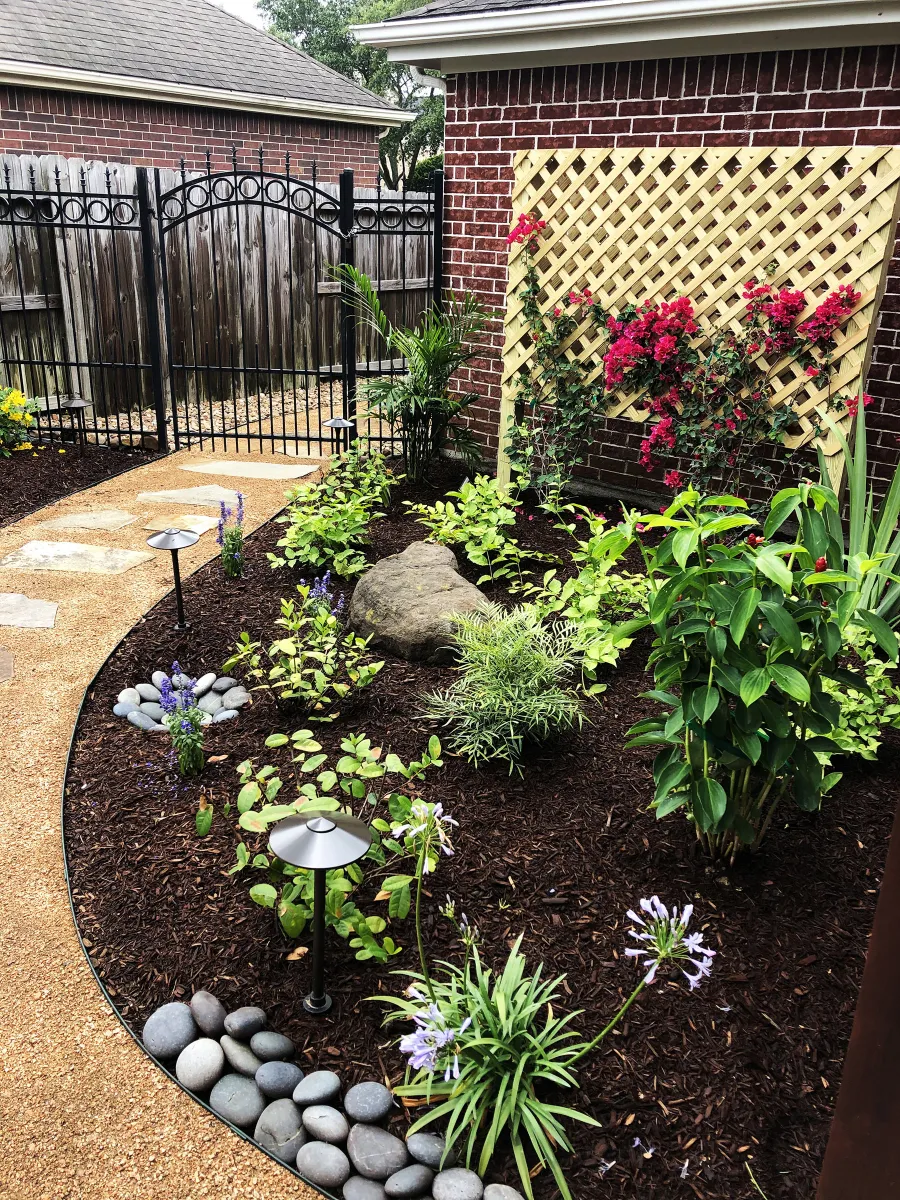
You have probably driven past both versions on your own street in Cinco Ranch. One house looks composed after dark, with a few trees lit and the walk readable. The next one has a row of identical fixtures marching up the sidewalk like a runway. Same budget, very different result.
The difference is rarely the fixtures. It is where they point and how many of them there are.
What lighting is actually for
It helps to separate two jobs, because they want different answers.
The first is safety. Steps, grade changes, and the path from the driveway to the front door should be readable without anyone thinking about it. That job needs surprisingly little light, and it wants the light aimed down at the ground.
The second is showing off the landscape you already paid for. Beds, specimen trees, and the architecture of the house itself disappear completely at sunset unless something is lighting them. That job is about contrast, not brightness.
Most bad lighting comes from trying to do the second job with fixtures meant for the first, or from using one brightness everywhere and flattening the whole yard out.
The three moves that do most of the work
Uplighting trees. A light at the base of a mature oak aimed up through the canopy is the single highest-impact thing you can do to a yard after dark. It gives the front of the house depth, and it uses something you already have rather than adding an object. Two or three trees lit well beats ten fixtures scattered around.
Path lights, used sparingly. The runway effect comes from spacing fixtures evenly and using too many. Real paths are better lit with fewer lights, staggered rather than paired, placed where the walk actually turns or changes height. You are marking the path, not outlining it.
Bed accents. Low light worked into planting beds picks out shrubs and stone borders and keeps the beds from reading as a black void next to a lit lawn. This is the layer people skip, and it is the one that makes a yard look designed rather than lit.
Those three are most of what our lighting work consists of, because they are what actually reads from the street.
The mistakes that show up later
Too much light. The eye adjusts to darkness. What looks subtle on a showroom floor is glaring in a dark front yard, and brightness everywhere removes the contrast that made the good version look good.
Glare into eyes. A fixture aimed so you see the bulb from the sidewalk or the living room window is a fixture aimed wrong. Good aiming lights the object and hides the source.
Ignoring how plants grow. This is the year three problem. A light positioned perfectly around a young shrub gets swallowed when that shrub doubles. An uplight at the base of a tree gets blocked as lower branches fill in. Lighting installed into a landscape needs to account for what that landscape is going to become, which is part of why we would rather do it alongside the planting than as a separate trade.
Forgetting the boring parts. Transformers and timers are what make the system actually come on every night without anyone thinking about it. A timer that drifts, or one nobody adjusted when the days got shorter, is the most common reason a nice lighting system stops feeling nice.
Why this reads differently in 77450
Lighting is more noticeable in a master-planned neighborhood than almost anywhere else, because the houses sit at similar setbacks on similar lots and the eye compares them automatically. On a street where most homes are dark at the curb, two well-lit trees make a house look finished. On a street where several neighbors already light theirs, the unlit house is the one that stands out.
The mature tree cover across the older parts of Cinco Ranch and 77450 is the real opportunity here. Uplighting works best when there is something worth lighting, and a twenty-year-old oak in a front yard is exactly that. It is also the reason aiming matters more here than in a newer neighborhood, where the trees are still small enough that a fixture can simply be pointed up and forgotten.
What maintenance actually looks like
Outdoor lighting is low maintenance, not no maintenance.
Fixtures get knocked out of aim by mowers, pets and weather, and a light that has rotated two inches can go from flattering to glaring. Lenses get covered in soil splash and mulch. Beds grow over fixtures. None of that is expensive to put right, but none of it fixes itself, and a system that nobody has looked at in three years usually needs an hour of aiming more than it needs parts.
If you already have lighting that has stopped looking the way it did when it went in, that is often the whole problem.
A simple way to plan it
Before anyone quotes you anything, go stand in your own front yard after dark. It sounds obvious and almost nobody does it.
Look at what you actually miss. Usually it is one or two things, a good tree, the entry, the line of the beds along the front. That short list is your plan, and it is nearly always shorter than what a catalog would sell you.
Then walk the path from where people park to where they knock, and notice where you would want to see your feet. Steps, a turn, a grade change. Those are the spots that need a fixture, and the straight flat stretches between them usually do not.
Doing that one walk tends to cut a lighting plan roughly in half, and the half that survives is the half that was going to do the work anyway. It also gives you something concrete to point at when you talk to anyone about it, instead of starting from a fixture count.
Where to start
If you are adding lighting for the first time, start smaller than you think. Light the two or three things genuinely worth looking at, get the walk safe, and live with it for a few weeks. It is easy to add a fixture later. Pulling back from an over-lit yard is the harder direction.
And if you are already planning bed work, do the lighting in the same conversation. Running wire through a bed before it is planted is simple. Running it afterward means disturbing work you just paid for. We handle lighting with the rest of the yard for exactly that reason.
Free consultation in Cinco Ranch, 77450 and across Katy and West Houston if you want someone to walk the yard with you after dark and point at what is actually worth lighting.